
John McDonald

Blogging about politics, life, and the web

Need Hosting? Get a coupon for Dreamhost or Hostgator first

July 29th, 2009

If someone wants to get a website online, the most essential component (and the one that almost always requires some cash investment) is the hosting service.  The host stores the actual data of the website and connects it to the web, so the decision is an important one that will affect how fast your sites are and how reliable they are at staying online. In addition to physically connecting your website data to the internet, hosts also provide a lot of features designed to help you install website software and manage your domains.

One popular choice for non-commercial web publishing is free hosting.  This can be obtained at places like Blogspot, WordPress, or even Facebook and Myspace.  These sites provide the hosting for free and give you everything you need to publish content to the web, but with the exception of Blogspot they’re not interested in helping you build a commercial site.  They’d rather keep the profits your content generates to pay for their own hosting and promotion expenses.

Shared hosting – cost effective and business friendly

One step up from free hosting is shared hosting – a service that allows multiple webmasters to share the resources of a single server machine.  Shared hosting gives webmasters more control over the look and organization of their sites, and there are rarely any limits on commercial activity (other than legally prescribed regulations, of course).  Most hosting accounts also allow you to run multiple domains off the same service, so there’s really no external limit to the number of sites you can build.

Hosting coupons are available

Like any other business, hosting providers are competing for customers.  One way they do so is through coupons, promotional codes, and other discounts that allow the buyer to customize the service, features, and price they’re willing to pay.  To help get the word out, affiliates can also earn money when their personal hosting coupon or code are used to make a purchase.

Dreamhost Coupon Codes 2012:

Dreamhost is the shared host this site is published on, and its served me well for the installation of multiple WordPress and Pligg domains under a single hosting account.  They also have a huge selection of Dreamhost coupon codes to choose from, so there’s never a reason to pay full price when you’re signing up:

  • Saves50 – $50 off
  • 3free4life – 3 extra free domain registrations for the life of your account
  • BizAndBlog – 1 extra free domain registration and $30 off
  • BizCode – $20 off and a dedicated IP address
  • 218233078703 – use this code to get $150 off a 5 year plan or $200 off a 10 year plan!

Hostgator Coupon Codes 2012:

Hostgator is another popular web host, but I don’t have as much experience using the service.  Its highly recommended and I’ll probably invest in my next hosting account with them (whenever its time to diversify again.)  Hostgator coupon codes are also available to secure a discount on shared, VPS, or even dedicated hosting in case your site is already bringing in heavy traffic and you need more CPU time.

  • Green – 20% off the purchase of any new account
  • WordPress – 1 penny for the first month of service

There’s no catch, just pick your favorite coupon code and add it to the promotional code field during account registration.  Entering a code will give you a new cost calculation or upgrade your service – so be sure to take advantage of this discount opportunity.
For Sale, For Rent, Foreclosed..

July 27th, 2009

Driving through my neighborhood, this is the story of housing written on the front-yard signs and plastered to the walls of crumbling homes.  There’s no way to exaggerate this:  a full half of the houses between mine at the main road are abandoned. And this isn’t some “main road” out in the middle of nowhere, it is about five miles to the beach, downtown, or the financial center of the city.  This is a main road for a city with an NFL team and almost a million residents.

Even during the bubble, this neighborhood wasn’t too popular unless people were coming in to build expansions.  The houses were originally built in the 1950s as military housing for the nearby naval base.  The construction is solid but the space is modest:  concrete blocks apportion a meager 1,000 square feet.  During the construction boom, people were more willing to buy 3,000 square feet worth of plywood and chinese drywall.  I always wondered why people bought weak-walled homes in the middle of a hurricane zone, but I suppose the entire housing situation has been an exercise in insanity.  Credit was plentiful, exuberance was irrational, and no one was really thinking of the future.

That future is today, and the “For sale, for rent, foreclosed” signs don’t come down:  they just devolve to the next level of seller desperation.  When they realize the house won’t sell, they try to rent it out at a loss.  At least they’ll be able to avoid foreclosure, right?  Not yet – every house that goes empty here is soon bank owned.

The first empty house is a fixture on our street.  Its two houses down and its one of the bigger ones on the block at a stately three bedrooms and 1,700 square feet.  It even has.. er.. had a pool.  This one has been empty since we moved in nearly three years ago.  It seems to be owned by some trust fund, but the only ones living there are raccoons, wild weeds, and mosquitoes.  Every applicance, piece of hardware, and inch of copper pipes has long been stripped, and the windows are boarded up with a cheap plywood that is now also starting to rot.  The online listing claims the property is for sale at the low price of $60,000, but the city posted notices on the front door announce that the structure has been condemned as unfit for human habitation.  Of course, the city doesn’t have funds for demolition…

Two doors down again, there’s a jungle of weeds where one of the street’s nicest gardens used to be.  A more modest and average house, this one is two medium bedrooms and a small screen porch.  One day, we realized our neighbors weren’t outside tending the yard (it really was a nice yard…).  A week later, there was still no sign and the weeds had sprouted a few extra feet.  The court records say foreclosure, the family must have been forced out.  This was two years ago, and there’s no for sale sign, no listings online, and no visible maintenance.  What good does this do the bank, the neighborhood, or the crafty gardener who used to call this place home?

A corner house sits “For Sale or Rent.” The new job they moved for must have paid well if they’re able to sit on an extra mortgage for the last few months.  But again, there’s no real estate agents showing the place off or curbside shoppers slowing down to take a second look.  Next to them, there’s another empty house for just $29,000.  The bank kicked out the mortgage borrower when he was almost done paying, and you could buy his home instead for a fraction of what the other houses cost.  You even get the shed and the garage he spent all those afternoons and weekeneds building.

A few blocks down the other way, my friends just walked away from a mortgage.   They each had a home, so when they got married they had to rent one out.  After years of sucking up the loss on tenants who would not pay the bills or keep the place clean, real estate agents were not even willing to attempt a sale in this market.  So my friends are at least fighting back:  They’re taking the risk back to the bank.  State laws will, of course, give the banks a chance to sue for their losses, but we’ll see if the courts find anything but profit and bailouts in the bank’s books.

It could go on and on…

This isn’t an economic story or a financial abstract that informs your investing patterns:  this is a human story and an utter failure to act humanely. As we throw people on to the streets, we let resources sit idly and ultimately decay.  Rather than write down the value of our debts and assets to a realistic and sustainable level, we’re watching those assets drop to zero and the debts spiral due to a mix of fines and eventual demolition costs.

It would appear, however, that the insanity of our financial system didn’t end with the boom…

Obama Approval Rate Dropping – Is he too Conservative?

July 26th, 2009

Just six months after taking office, there is a clear trend across multiple polling firms:  Obama is losing popularity.  While a majority of likely voters still approve of the job the president is doing, the rating has dropped more than ten points from post-election highs.  Its doubtful that many McCain voters ever supported Obama at all, so who is he losing popularity with, exactly?

On healthcare, Obama seems to take criticism from both sides.  Republicans and insurance industry lobbyists are working overtime to convince voters Obama wants to go too far toward socialism, and to the left there are complaints that Obamacare fails to guarantee coverage to everyone.  In addition, Obama is being blamed for the fact that Congress has stalled out on the terrible “compromise” legislation.  I think, at the very least, there needs to be a public health insurance option, but a more ideal system would provide every American with basic preventative and catastrophic care.  Some industries lend themselves to competitive markets:  medicine and banking simply don’t seem to be among them.

On foreign policy, Obama is also fending off charges that his policies are too Bush-like.  Despite the much-celebrated “withdrawal” of U.S. troops out of Iraqi cities, the timetable for this plan hasn’t changed a bit since Bush was in charge.  In Pakistan, U.S. bombing campaigns have accelerated despite high civilian casualties, and comments recently made by Hillary Clinton suggest this may be the next front in the ground war against that abstract enemy known as “terrorism.”

On the environment, the much publicized carbon tax brings a whole new type of profit to financial firms like Goldman Sachs and JP Morgan, but there’s little evidence that its an effective way to clean up our toxic messes.  Carbon dioxide remains a proxy for real environmental outrage, while the administration approves permits for mountaintop removal and logging in our largest temperate rain forest.

On the economy, there’s been a lot of money spent and no real moves to correct the reckless behaviors that brought us to the brink.  In fact, its more like protecting the instigators from the consequences of their financial mistakes.  From Paulson to Geithner, Goldman remains in charge of the Treasury – and Obama has made headlines by appointing even more GS alumni to high ranking posts.

Strategically speaking, Obama’s centrist path seems like a safe way to get re-elected.  A divided Republican party offers little real competition to perpetuating the status quo under a slightly different rhetorical spin.  Instead, Obama’s greatest vulnerability may be from progressives, civil libertarians, and economic populists who were expecting a bit more change than this.

What’s $24 Trillion Between Friends?

July 20th, 2009

Bloomberg reports the top TARP inspector will testify that federal financial system bailout liabilities could be as high as $24 trillion, drastically surpassing the $700 billion specifically authorized under the actual TARP legislation.  Of course, the Treasury is defending their involvement, stressing that these numbers are theoretical maximums rather than spent dollars.  Assuming the assets behind the banks’ balance sheets are worth more than zero, the actual cost to tax payers should be significantly lower.

Fear and Foolishness

In time, it is likely that the TARP program and associated financial bailouts will be viewed as similar to the war in Iraq:  a series of expensive lies rushed through in a climate of public fear.  The official line of supporters at the time was that a failure to act decisively would result in some sort of apocalypse.    Instead of asking if we had gone too far, people were still asking if we had gone far enough.  Well, $24 trillion later, how is your view of the economy?  Mine still sucks…

Congress is a Small Fish

Essential to understanding this story is recognizing which government institutions are shelling out the cash.  Congress specifically authorized $700 billion dollars, but much larger guarantees and asset insurance has been provided by the Federal Reserve and the Treasury Department.  You’d think decisions about our dollars would be made by our elected representatives, but they’ve outsourced their responsibilities to opaque and insulated departments.

There Goes the Neighborhood

The only thing that seems to have been accomplished was keeping the banks who owned all the bad mortgages in business.  And that’s good right?  I mean, who else would foreclose on my neighbors when they lost their jobs?  On my short street alone, we’ve got two homes that have so long been abandoned by their bank owners that they’ve been stripped of everything valuable and slated for demolition.  Another one must be getting close to worthless:  They’re asking $29,000 for a 2 bedroom.

This surge in vacancy won’t be limited to my subprime hood, next year will be the collapse of the jumbos and ARMs.  Expect the next wave of carnage to wash up in the $500,000 housing range.

In the meantime, I’m trying to figure out how much it will cost me to buy the street.  Its in a really nice location, despite the property owners’ (banks’) lack of upkeep.

Florida Cigarette Price Doubles in Three Months

July 14th, 2009

Between the recent federal tax increase in April and the state tax hike that went into effect earlier this July, cigarette prices have nearly doubled in just three months.  At the start of 2009, I could pick up a carton of smokes for about $28 after tax – and the current cost is closer to $48.

Of course, my recent trip to Ireland helped me realize how good we still have it.

The first day we arrived, Aisling’s uncle wanted to take us for a drink and a meal at the neighborhood pub.  Oddly enough, smoking wasn’t allowed in the pubs (or anywhere really), so I joined the crew of outcasts enjoying nicotine in the windy rain.

A younger guy approached me, flashing a 10 Euro bill (about $15) and begged me to buy him some cigarettes.  I tried to decline – even insisted that I had literally just walked off the plane and didn’t want to get in to trouble.  I didn’t ask his age, but he had the persistance of a slightly-underage addict that I could relate to all too well from my days of loitering around the convenient store and waiting for someone willing to acquire a pack of Marlboros.

Well fine, I couldn’t get rid of this guy so I offered to sell him a pack of cigs I brought with me from the states.  I originally paid about $32 for the carton, so I figured a fair price would be at cost.  When I asked for 2 Euro in return, he looked shocked – but in a way that he didn’t want to miss the opportunity.

He exclaimed “Stay right here, I’m going to get change!” and he dashed into the pub.  A few moments later he handed me 2 Euro and seemed to display a brief moment of guilt.  “Are you sure you only want 2 Euro?”

“Yeah, sure, that’s all I paid so its only fair.”  Of course, I never thought to ask how much they cost on that side of the pond.

A few days later, the few packs I brought started running low.  We were still staying in Dublin at that point, so that corner pub was the closest shop.  I fished a few coins out of my pocket and walked up to the bar to order a whiskey, a coke, and a pack of Marlboro Lights.

“14 Euro”

“What?!”

“That’s the price:  8.50 eu for the cigarettes, and 5.50 for the mixed drink.”

And at that moment, I realized I was willing to pay about 13 US Dollars for a single pack of smokes – and maybe our sin taxes aren’t so bad.

In Northern Ireland, the tax is a little bit lighter.  Packs are sold for about 7 euro ($10-11) or you can buy loose tobacco and 20 rolling papers for about $4.  No wonder everyone was rolling their own smokes…

Economically Regressive, Medically Progressive?

By definition, cigarette taxes are regressive – people with lower incomes end up spending a higher percentage of their wealth on the tax itself.  Rich people don’t really smoke more cigarettes than anyone else who smokes, they just spend a much smaller part of their income on the fix.

At the same time, sin taxes are popular because they may theoretically bolster progressive goals like reducing illness and funding for medical care.  Gas taxes sort of work the same way:  They’re a heavier burden on the working poor but they theoretically accomplish the goals of reducing consumption and funding environmental cleanup.  Then again, I remember when they told us the lottery was going to fund education and college scholarships.  That lasted a few years before they finally decided to slash the scholarship budget and transfer the lottery proceeds to the general fund.

So I’m a bit mixed on it all.  I certainly don’t enjoy spending near $50 for a carton of cigarettes but there are probably worse ways the state could try to raise revenue.  At least they haven’t put a sales tax on food yet – that would be an incredibly destructive and regressive tax.

In the meantime, I’ve had to dust off the corn cob pipe to save some cash.  While the price of pipe tobacco has also doubled in the last few months, it is still the only way to get a nic-fix for less than $20 a week.  Of course – it could be a whole lot worse.

Healthcare Costs must be Contained with a Public Plan

July 13th, 2009

The recent Congressional debates over healthcare reform have been a model in special interest lobbying and out of touch representation.  Big money in the medical industry is using its influence to make false claims about how expensive public healthcare is or how effective our current American medical system is in keeping people healthy.

If you’ve been reading my sites and posts before, you might be a little bit confused as I usually argue toward the libertarian end of things and now I’m suddenly calling for a public health system.  And yes, I might be a little biased against government solutions and market interventions, but we can’t let ideology blind us to the facts.

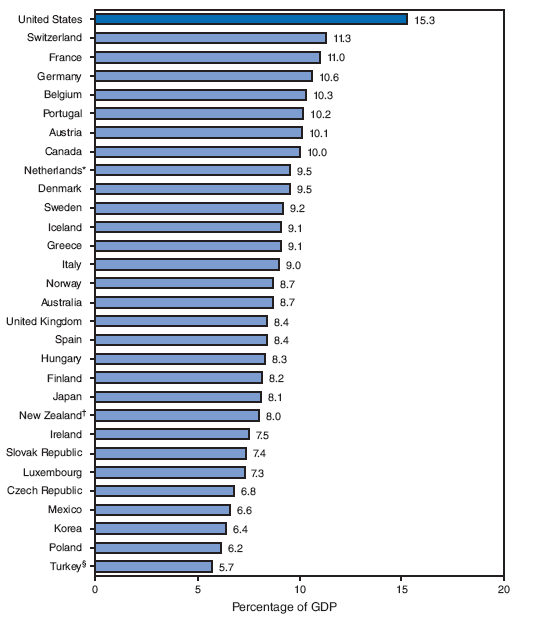
Fact #1:  U.S. Spends more of its GDP on healthcare

healthcare-gdpThe CDC published the 2006 data on health care as a percent of GDP, and its clear that the American version of private for-profit care comes with a higher price tag than comparable medical care in similar nations.  In 2008, things were even worse:  17.6 cents on every dollar generated were spent on medical care.  If the GDP continues to decline and nothing is done about costs, we will soon spend more than 20% of our GDP on this one expense.

Fact #2:  Americans are not Healthier

The CIA World Factbook ranks America at #50 for life expectancy:  this is well behind most of the European and Asian nations that we’re outspending.  And despite all of the money we’re spending and the attempts to subsidize private profits in the sector, we still have tens of millions of people who can’t get access to the preventative treatments they need to stay healthy and employed.

Fact #3:  The Status Quo is Bad for Business

Unless you’re in the insurance or pharma industries, the current system is a dead weight on your company’s bottom line.  Employees who do get coverage from their jobs are costing a lot of money to their employers, and the annual rise in costs cuts into the same HR budget that would have funded your raise or the assistant you’ve been hoping for.

Workers who don’t have coverage are in an even worse spot, because they often can’t afford to buy insurance.  Rather than get treated and tested early, they end up struggling through sickness and eventually showing up at the emergency room in need of urgent care.  Of course, that care still has to be paid for – and its still going to come out of the pockets of taxpayers and insurance indirectly.

The Illusion of Competition

We Americans take great pride in the concept of free markets, but what exactly does that mean?  One thing implied by a free market economic sector is the presence of competition – something we don’t really have in our for-profit medical system.

If you’re seriously injured in an accident and need emergency surgery, you don’t have time to research your hospital choices.  You’re not exactly in a good position to argue with the ambulance driver, either.  Likewise, people don’t usually turn down employment because the medical benefits are too expensive or purchased from an unreliable provider.

Yet that’s not it:  There are also strict laws, inspired by lobbyists, that prevent insurance from being sold across a national market.  State mandates help fragment the insurance market-place, and this generally leaves fewer alternatives based on location.

Healthcare, like roads, is something that everyone needs.  There are inherent limitations to how much competition can exist in these markets.

Single-Payer Makes Sense:  A Public Option is Minimally Acceptable

American healthcare doesn’t demonstrate the cost savings expected of a free market, and the result lags behind nations with public systems.  The current model leaves little incentive for early (and often cheap) cures, because there is a lot of profit to be made on patients with chronic illnesses and chronic pain.  Instead, surgery is a big ticket item, and some are often oversold.

It is also important to remember that a public single-payer system does not mean the total elimination of private insurance options.  Just because everyone would be covered for basic necessities does not mean that affluent individuals couldn’t find extra insurance.  In France, a vast majority of the population still carries private insurance supplements.

If a single-payer system is too radical of a change for the American public, the minimum acceptable choice is a competing public insurance option.  If provided at cost, this federal insurance plan would force the private insurance industry to cut costs and provide better care.

Conversely, any attempt at universal healthcare that does not include public competition will simply subsidize the insurance companies even more – and mostly at the expense of the lower working class.  Some proposals have amounted to forcing everyone who works at McDonalds and Wal-Mart to buy their own insurance – and while it sounds absurd, it would be great business news for the stock owners of private medical companies.  Of course, the stock owners’ club includes more than a few members of Congress so the chances of this happening are higher than I’d like to admit.

The bottom line is this:  We need to slash healthcare costs and all indications are that a non-profit public competitor is the way to go.  We need to stop asking if we can afford universal coverage and start asking if we can afford to go without it any longer.

In Defense of Music and Standards

July 9th, 2009

In response to:

Michael Jackson’s Death Was Tragic, But He Was Little More Than an Icon of Mediocrity

By Alisa Valdes-Rodriguez, Alisa Valdes-Rodriguez’s Blog. Posted July 9, 2009.

He was not a musical genius; didn’t break down racial barriers; wasn’t a great dancer; didn’t change American culture…

Alisa Valdes-Rodrigues is saying something a few of us have thought by now.  It seems a lot of people leaving comments don’t agree – But let’s face it:  Musicians are music snobs… and so what if it sounds pretentious?  Writers are book snobs and engineers frown on half-assed constructs.

Until you’ve picked up an instrument or three and put the required time toward learning how to play, you’ve got no relative concept of the effort & emotion that goes into creating that music.  Without those insights, there’s still a musical product fit for mass consumption – but its value is ultimately calculated by the ability to generate revenue.

I get where the negative comments are coming from – really.  If you haven’t been playing guitar for 2+ years you probably don’t appreciate death metal solos.  If you’ve never sat in a symphonic arrangement, you’re somewhat detached from the performance.  If you’ve never written a song, how could you appreciate what goes into performing your own originals or how it differs from covering someone else’s composition?

The “greatest” and “best” pieces of art can not be enjoyed passively.  They are way too deep and they require too much of the audience’s active engagement.  They are designed to make you think, contemplate, over-analyze – and they assume you’ve grown up from the introductory fare to face the bigger and tougher questions.

This may be why musicians tell you that the music in your iPods sucks: Because it does.  Popular music is missing elements and potential that its fans may not be aware of.  If MTV says it was groundbreaking, you can safely bet that someone did it generations earlier.  That doesn’t mean one can’t or shouldn’t enjoy “popular” music:  Not everyone is drawn to spend so much effort for music just as not everyone becomes an author or an engineer.  There is still some sort of combination of skill and luck that goes into creating global popularity, even if it isn’t enough on its own to impress dedicated connoisseurs.

Many will dismiss Alisa’s call for cultural quality as sour grapes or stereotypical Gen-X cynicism, but there’s a valid point amid the gloom.  The reward for mediocrity seems to be fame and millions – the reward for art appears to be an existence on the margins of culture: a cramped stage in an underground bar or a yawning audience in a half-empty hall. If there’s anything I really disagree with in this article, its the claim that Michael Jackson was himself a member or a symbol of Generation-X.  Most definitions of Gen-x start with births in the mid 1960s, and Gen-x music is more definitive of modern rock music than Michael Jackson will ever be.

In related news, the music industry faces record-breaking losses (again).  Apparently, they really believe that this is the best American music has to offer and can’t imagine something better.

Banks Back Off – California IOUs in Limbo

July 9th, 2009

In my last post, I was starting to think that the banks had a really sweet deal in this crisis.  First they get to take first cut of profits on mortgages that actually weren’t profitable, then they can take cheap loans from the government.  If they wanted to put those cheap loans into safe profit margins, they’d just have to use the federal government’s money to buy up state bonds & IOUs.  But hey, who wants a few measely percents in interest?

The big stinger is that right up until these IOUs hit the street, these banks had announced their willingness to pay face value.  Once they were printed up, distributed, and ready for deposit – the big banks decided they would stop buying them after Friday.   Companies bailing on the bailout include:  Bank of America Corp., Citigroup Inc., Wells Fargo & Co. and J.P. Morgan Chase & Co.  You may recognize these guys as some of the biggest beneficiaries of recent federal bailouts in the financial sector and the ones currently sending bidders to the discount window.

So what inspired the change of heart?  Was it Fitch’s recent downgrade of California’s debt payment prospects?  Or was it the fact that they realized IOUs were already being exchanged at a discount off face value…?

The state has announced that they intend to honor interest payments and redemption of the IOUs bought on the market, so the refusal of banks to take them as deposits means they’ll be left to the market price.  Check cashing establishments and speculators are reportedly scooping up the certificates for about half of face value.  In October, they’ll be able to sell these back to the state at face value plus interest!

Once again, the government has intervened to “fix” an economic mess it created.  The result?  Anyone who lives check to check gets sold out for pennies on the dollar, and those with plenty of cash lying around have a guaranteed profit opportunity.  I’d say I’m surprised, but this seems to be the contemporary standard of political-economy.

As California Goes…

July 6th, 2009

So Goes the Nation

It has often been said that California is a trendsetter among states – anything that comes to pass in Cali will eventually find its way throughout the nation and into federal policy.  From social movements to Hollywood and internet first-adopters, there’s always been a sense that the future was already happening on the west coast.

If this maxim, “As California goes, so does the nation” proves to be correct again, then the rest of us had best pay some attention to the current financial crisis and how the politicians have chosen to deal with it.

Faced with rising costs and declining budget revenue, they’ve indirectly chosen a solution out of fear of making tough decisions.  The printing presses have literally been fired up, and the state is issuing IOUs.  While these are technically bearer bonds paying at 3.75%, the state is rumored to be printing them on dark green paper and encouraging banks & businesses to treat them like cash.

And How Far We’ve Gone

For most of America’s history, cash has been backed by some sort of commodity.  Gold has long dominated as a medium of exchange, and silver has also been used as payment for paper notes.  FDR figured out to devalue the dollar for a more flexible monetary policy, but Nixon figured out how to get Americans to give up all the tangible value of their money itself.

With no commodity backing the currency, the only thing that stops California from ordering a few trillion from the Treasury is political will and a fear that we’ll eventually go “too far” and ruin the dollar’s reputation as a reserve currency.

Let’s be honest anyway, someone who had invested in dollars under the gold standard would be brutally unprepared for something like retirement.  Other nations have been sending “stuff” to America in exchange for these dollars, so they’re the ones taking the investment losses.   Some have started inflating their own currencies in defense (see Japan’s carry-trade), some are also openly calling for a new monetary regime. With financial heavy-hitters like Russia, India, Brazil, and China meeting to discuss alternatives to the dollar, this dollar reserve reckoning day seems like it may be closer than we’d like.

So instead of being paid in a dollar that is literally “as good as gold,” residents of California will be receiving a debt promise – and the interest on that debt is going to come out of the future taxpayer’s pocket… somehow.

Heads or Tails?  The Bank Wins

If the government itself is in a cash crunch, who has the liquidity on hand to give state workers real cash in exchange for their state IOUs?  Conveniently, we’ve just pumped a few trillions of liquidity in to the banking system and these banks are more than happy to trade IOUs for dollars.  By some accounts, transfers and insurance policies have added five or six trillion dollars to banks’ balance sheets, and they’ll be able to use this money to buy up as many IOUs the states can print out. Of course, the banks were supposed to use this TARP & bailout money to extend business & consumer credit, but those individuals and small groups seem like a big risk compared to the state itself…

Eventually, California will figure out how to raise taxes or cut services (or probably some combination of the two).  In the meantime, the banks will collect a nice stable interest payment in a chaotic economic environment. Indeed, we’ve fallen a long way from paying workers out in gold – we’ve leveraged our paper treasure against our own citizens for the benefit of the banks.

Can We Break the Spiral?

Financial dissent is our secular heresy:  of all the thoughtcrimes, perhaps none is so shocking as questioning the nature of what we call modern capitalism.  As a society, we have invested so much collective faith into this abstract concept that we are unwilling to reform the root causes and financial power centers – even if they are relatively new institutions that conflict with older parts of our national identity.

Its never even clear what it is that we have faith in.  Is it the politically connected speculators or the regulators handing them our tax money?  Either way, solutions must be kept on the edges of their playground – suggesting significant core reforms is a sure-fire way to be uninvited from offering your opinion next time.  As long as this paradigm rewarding blind faith holds, things will continue to decline in a slow and methodical way.  At the next wave of mortgage resets, there will be another rather steep cliff, but odds seem high that we’ll cushion the banks and resist substantive changes.

Its not a great outlook, but I don’t believe anything can get significantly better until our so-called leaders take on some of these tough decisions and set up institutions designed to promote general wealth and opportunity.  Fundamental changes in our approaches to credit and money has to pay bigger dividends than bailing out the same bank for the fourth time…

Are You Watching Death Note Yet?

July 5th, 2009

What happens when you give a bored and over-achieving honor student the power to kill anonymously across vast distances?

If the answer involves Japanese heavy metal, high quality animation, and Gods of Death, you’ve got Death Note; an animated series from across the Pacific. It was recently dubbed to English and is currently distributed by my favorite late-night network, [adult swim].

A magical book literally falls to the earth and Light Yagami is the one to find it – the instructions printed on the book inform him that anyone whose name is written on its pages will be killed.

While skeptical at first, Light Yagami finds the temptation to punish the villain and save the victims is overwhelming.

Eventually seeing himself as an ideal arbiter of justice, Light begins his quest to rid the entire world of every single criminal and person he’s deemed evil or unfit to live in the utopia he dreams of.

[adult swim] is even generous enough to put significant chunks of the story online for sharing. Check out this video of Light realizing the scope of the power he’s acquired and how he initially justifies its use:

Philosophical questions, psychological drama, and even cliff-hanging detective-story themes run against a backdrop of religious and spiritual imagery. Light’s quest to create a perfect world is popular with some, but the pattern of his killings also attracts the attention of international law enforcement institutions who aren’t too thrilled with the concept of an independent and unaccountable angel of death.

As the magnitude of Light’s power grows, a mysterious and legendary detective known only as L makes it his personal mission to arrest Light and bring him to justice for all the deaths of criminals he’s been responsible for.

Hero or villain, savior or devil – you might not know who to root for through large parts of the story arc.

These clips come from the first episode or two – so don’t worry about this little introduction spoiling too much of the story. There are plenty of twists and turns and unexpected developments ahead!

Unfortunately the show is only airing at 3:30 am on Sunday mornings (Saturday night) but I understand that the DVDs are also available now. I’m personally waiting for the price to come down a bit or for a box set including all episodes to come out, but if you haven’t seen the series yet I’d recommend getting yourself a copy of it as soon as you can!