John McDonald

Blogging about politics, life, and the web

Late August, No AC, What to do but Complain?

August 31st, 2009

Some time late last night, the power in the house flickered for a second and within fifteen minutes we noticed it was getting a bit warm.  A bit warm was an understatement… Despite the AC fan continuing to blow air around, the actual cooling systems must have shorted out because the outside fan was suddenly silent.  And the temperature kept creeping up…

In fact, from midnight to six a.m., the temperature inside the house didn’t drop below 80 degrees once.  Opening the windows hasn’t done anything about the temperature either, the outside air is humid and still.  There’s not a hint of wind or a cloud in the sky, so as the sun comes up here soon this inconvenience is likely to become misery.

I guess the good news is that the repair shops will be opening up about the same time the heat becomes unbearable.  Of course, this probably means spending a ridiculous amount of money, but there’s no way we can live here without an AC like we managed to make-due when the dryer broke.  And while we eventually fixed both the washer and the dryer on our own, I don’t think we’ve got the slightest idea of how to repair an AC compressor.

Oh well, this one should cost me a few hundred dollars I don’t really have but there aren’t many options available.  I’m starting to remember why so few people actually settled in Florida prior to the arrival of climate control.

Who is in Charge of the U.S. Dollar? This guy, unfortunately

August 28th, 2009

Ben Bernanke, the chairman of the Federal Reserve appointed by Bush and now re-nominated by President Obama:

Well, unfortunately again, Bernanke will be back for at least a few more years unless the Senate steps in and shuts down his recent re-nomination. A few Congress-critters have put up a fuss about it, but chances are good that Obama’s nod will be upheld. It turns out that a lot of people give the Federal Reserve credit with “fixing” the financial crisis after the fact – things didn’t turn out to be nearly as bad as they warned us it would be.

Then remember September last year? What a quick turn around, he was suddenly in front of Congress insisting that we open up the floodgates of new cash to the banks, or we’d face an apocalyptic financial nightmare.

What exactly happened to all of that money is still up in the air. You see, the Federal Reserve doesn’t want anyone to audit their monetary policy.

Since monetary policy is the Federal Reserve’s essential function, pretty much any action can be labeled as sensitive and kept secret. Even why they let certain firms and how they’re spending of trillions of dollars:

Do you know who received a cut of the Federal Reserve’s trillion-plus balance sheet transfers? Of course not. No one does – outside of the Fed.

Of course, Bloomberg is trying to find out – and the judge even sided with them in ordering the Federal Reserve to turn over records of exactly who is benefiting from their policies. Anyway, Bernanke and our other “public servants” at the Federal Reserve can’t imagine any scenario so dire as simply fessing up about what they’re doing with their control over our money supply – and they’re trying to fight the federal court order.

So the story isn’t over, and one day we may have control over our own money back from the unaccountable and apparently ineffective Federal Reserve. If they’re supposed to be preventing panics, they’ve done a pretty bad job so far. Real employment continues to decline and housing prices recently posted double-digit year over year losses, despite government subsidies designed to encourage sales.

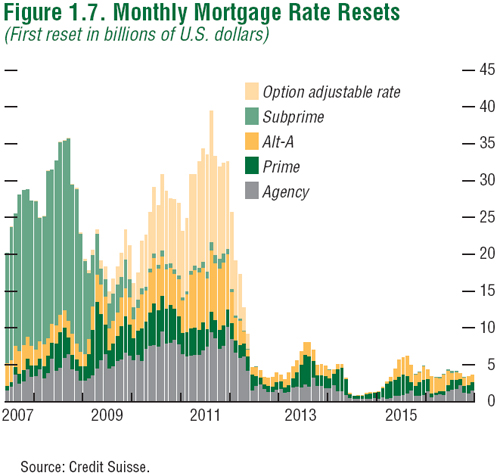
In November, these subsidies will expire and this effect is likely to compound the seasonal weakness of the winter months. And when Spring 2010 comes, instead of the regular seasonal growth, we’re likely to be swamped by the coming wave of Alt-A mortgage resets:

You say you’ve got good economic news? You see green shoots? I’d love to hear about it, but excuse me if I’m skeptical…

North Korea – Back and Forth at the Brink

August 17th, 2009

North Korea has been grabbing headlines as usual, and the nation’s recent actions have been described as erratic or irrational. Some speculators have suggested that the leader’s advancing age and failing health has inspired him to the ultimate confrontation, but he is probably instead trying to secure his legacy and the ascendancy of his chosen heir.

Defensive Paranoia

Understanding North Korea’s fear of invasion requires a look back on the last few thousand years of the region’s history. Before the Korean war split the peninsula in two, the Korean kingdoms had been invaded by Japan, China, Mongolia – just about any neighboring state has made some attempt at capturing the Korean provinces.

This 19th century cartoon depicts Korea as a fish being hunted simultaneously by China, Japan, and Russia.
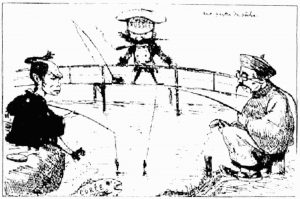
China_Japan_Russia_CoreeFor the Southern Republic, U.S. intervention in the cold war was an assurance of territorial integrity.  North Korea similarly enjoyed Soviet protection, but the collapse of the U.S.S.R. left North Korea on its own and in need of a defensive deturrant.  While many think of China as North Korea’s natural ally, the relationship between the two is actually rather strained as there are some debates over the historical boundaries that seperate the two cultures and their derivative states.

As iron and uranium are the primary natural resources available in North Korea, it should not be a surprise that these have been utilized as defense.  Iron-clad ships originated in Korea, so it should not be a surprise that they have retained the desire to stay cutting edge in their military options.  Failure to do so has historically meant a loss of sovereignty and paying tribute to foreign powers.

Nuclear Sabre Rattling

With a domestic supply of uranium and a history that promotes defensive paranoia, it was probably inevitable that North Korea would develop nuclear weapons.  Recently announced tests may have proven a partially-functional bomb, but the actual potency of Pyong’yang’s arsenal is unknown.  Kim Jong Il, of course, would like everyone to think they have full nuclear capabilities.  Chances are, the intent is to create a defensive deterrent.  While North Korea controls a large army and long rang bombing capacity, they have no hope in a direct war against either neighbor.  A fight with China or a U.S. backed South Korea would be extremely bloody and destructive on both sides, but even scenario would end with the defeat of North Korea through attrition.

Legacy and Inheritance

A few months ago, the missile launches, bomb tests, and threatening announcements were gaining momentum.  Some people thought he was trying to challenge Obama as a new president, and others suggested he was simply out of his mind.

What didn’t get a lot of coverage before North Korea faded to the back of the news again, was that Kim Jong Il had named one of his sons as a successor.  And suddenly after naming an heir, the rocket launches and nuclear bragging seemed to quiet down.  So what I see is a public display of power for the purpose of securing a legacy – not the behavior of someone who wants to commit national suicide.

Indeed, the latest announcement was that Kim Jong Il would be re-opening the contested border with South Korea.  After decades of seperation, the reclusive state will be allowing travel along the Korean peninsula.  Tourism and family reunions are expected to be on the top of the agenda as Koreans seek to reconnect with their own kin and cultural history.

Cultural Momentum Favors Unification

To paraphrase Lao Tzu, a storm or movement that appears suddenly cannot last for long.  Conversely, a thousand years of shared language and history is unlikely to remain divided because of fifty years of seperation.  Indeed, Korea has spent periods longer than this under outside control.

Kim Jong Il’s heir is his youngest son, a twenty-something with a decent education and a reputation for partying.  He may not have the ability or even the interest in keeping the North isolated, and he may realize that the corporate world even more favorable to building family fotures than the current dictatorship.  With the borders opening, trade is almost certain to follow.  So while I don’t believe the new leader will give up his clan’s prominent position, I do think he will be more open to tolerating a more open and competitive system.  Of course, all I can do is speculate baselessly, as the heir’s own words and actions will define the ultimate course of Korean politics.  But I will say, that despite all of the saber rattling and threats being exchanged, the actual chance of a military confrontation are falling quickly.

Hooked on Civilization 4 and Civ Beyond the Sword

August 16th, 2009

OK, so the Civilization line of games has been around for years now and it just keeps getting better.  Unfortunately, this means I’m spending more and more time on them.

In Civilization, you play as the leader of a nascent society.  You start off with in the year 4000 BC with a single city and one military unit for defense and exploration.  From there, you can build workers to improve the land around your city, and this increases your production of explorers, granaries, temples, and libraries.  When you’ve got enough military to defend against the wild beasts and barbarian raiders, you can train settlers to go out and build additional cities.

As the game progresses, players compete for land and resources while balancing financial concerns and scientific research.  New technological discoveries allow workers to build advanced improvements, and they can also open up new buildings and upgrades for the cities.  Certain techs will let civs who have them work on building world wonders – these are unique buildings that only go to whoever can finish it first.   Most of them provide benefits to all cities inside the civilization:  Stonehenge can expand the culture of all your settlements, and the Great Wall can protect every city from barbarian invasions.  In the medieval era, grand temples and cathedrals can spread happiness through the population, and industrial era wonders like the Statue of Liberty or Eiffel Tower can increase the output of cities.  Other technologies found religions when they’re discovered, and then religions can expand organically along established trade routes or more intentionally through the use of missionaries.

Will you pursue military conquest or a more diplomatic path to financial and technological superiority? Each civilization has its own strengths and weaknesses: unique military units, unique city buildings, and even unique attributes that give bonuses to the production of certain improvements or units.


I recently broke down and bought the $20 expansion that was released about two years ago:  “Beyond the Sword.”  I know, big spender, right? This x-pac adds a whole bunch of buildings, wonders, and new civilization leaders to the Civilization 4 baseline game.  For the most part, its Civ4 with more choices – but there are also random events shaping the course of the game and more depth to player vs. player espionage.

Religion has become an even stronger force in medieval era diplomacy: The Apostolic Palace wonder allows players of the dominant religion to make agreements and vote on united religious policies. Of course, this means crusades, embargoes, and other international intrigue.

So far, I haven’t had much of a chance to see all the subtle improvements in the expansion, but its just enough to keep this classic game fresh. With that said, I think I’ll go play for an hour before I have to head out…

FDIC Bailout on the Way?

August 16th, 2009

How do you know its the weekend?  Well recently, the best sign is that news is popping up about bank failures.  See, there’s this trend in politics and all types of public relations that really bad news should come out on a Friday afternoon or Saturday.  As someone who runs websites and has access to all kind of traffic stats, I can attest that these are times that people aren’t sitting around reading the news. In fact, the busiest times for news consumption are the hours you’d think people are supposed to be working…

Anyway, the FDIC and Federal Reserve know how to play the public relations game, too.   In the modern economy, appearances are just as important as realities – so what better time to announce failure than when no one is listening?

And this year alone, there’s been 77 banks achieving failure status.  Ouch.  The good news is, the FDIC is insuring all those deposits up to $250,000.  The bad news is, the FDIC now needs to come up with some more money in order to do so.

Reuters analyzes the assets and recent expenses of the FDIC here and figures they’ve got a few billion left to cover the growing losses.  Other writers are less optimistic in their FDIC analysis.  The real question to ask is, how bad off were these failed banks?  In a world where regulations and accounting rules shift on a whim, it might be impossible to answer that question even if you had full access to all the books.

Of course, the FDIC funds its insurance operations with a small fee from the banks with insured deposits.  And this means they can’t just increase the fee directly, because it would contribute to even more banks going out of business.  Really, the last thing the banks need is for their fees to go up.  So what is the FDIC ultimately backed by?  That would be the “full faith and credit of the U.S. government” and that means Congress will be sure to raise someone’s taxes or beg the capital markets to buy more of our debt. The “sound” banks will acquire competition and increase their market share, even if they’d be bankrupt too had it not been for TARP & discount window action.

If we get through this crisis without seriously reforming the high profits and public risks of the finance and banking sectors, we’re going to be in for a “recovery” that’s as bad or worse as the crisis itself.

“I don’t know what to write”

August 16th, 2009

I guess I’ve always enjoyed writing but I have to give credit to Mrs. Lotze, my fourth grade English teacher, for really teaching me to approach the written word as an exciting challenge.  Every Friday, we’d have a half hour of free writing time – and the only catch was, we had to write something.

“But Mrs. Lotze, I don’t know what to write!” some frustrated student would inevitably blurt out each Friday.

“Then write that.  Fill up your page with ‘I don’t know what to write about’ until you’re so sick of writing that that something more interesting comes up.”  She was serious – and it worked.

I was no more than six lines through the busy work when I gave the explanation a second thought.  Something more interesting… anything could be more interesting… and the breakthrough:  I can write about anything.

After that first day, the free writing period became my favorite time in school.  Around that time, I also started bringing free writing into my own personal time.  I started a few stories about zombies and made crude attempts at building characters and developing a plot.  People I knew or video game heros could all be inspiration for a written story, and I could explore the details of any subject that I wanted to know more about or explore my opinions of.

Plot and charcter turned into research, and the love of writing simply reinforced my love of reading.

Now I write every day, to the point where its become a drag.  I don’t always get to write about what I want about, because the business world doesn’t work that way.  When I do find time to write for fun, I often don’t know exactly what to write about.

But I should know better than to use that excuse – Mrs. Lotze taught us that well.