John McDonald

Blogging about politics, life, and the web

Airport Security Theater

July 2nd, 2009

I’ve mostly been able to avoid flying, so the recent trip to Ireland was my first experience with the changes since 9-11.  The last time I had flown before that was in the summer of 2001 – and that was enough security hassle for me so I rightly guessed the modern scene would be a total nightmare.

The most obvious problem is the scope of what they’re attempting:  a full inventory of every passanger and his or her belongings.  While they spare no expense in attempting to verify every single thing, they do spare time.  Everyone is being rushed through crowded corridores and I find it hard to believe that sneaking things through would be impossible due to the simple fact that so much is being examined in such a short time.  Sure, large metal objects will be found, but that was the case back when the metal detector was the only standard exam.

Its even possible that more time could be spent inspecting cargo and passangers by killing redundancy.  When leaving Dublin, I noticed that we had to pass through four American security checkpoints before boarding and leaving the plane.  Why is security searching people who just passed through U.S. security?  Do they think we picked up some terrorist hitchikers when we were seven miles above the ocean?

Incidentally, this is when my Irish whiskey became triple sealed.  First of all, they come in sealed bottles from the duty-free shop.  Now although the duty-free shop is after Irish airport security, it is before American airport security.  This means the sealed bottles of whiskey had to be sealed into a bag and stamped by a U.S. security guard to get on the plane.  That’s two seals but that’s not good enough!  When we landed in Philidelphia, we were informed that nothing from duty-free shops would be considered secured and we’d have to get them … yes … inspected and stamped by security.  This led to the third seal:  boxing up my sealed bag of unopened whiskey to be sent with checked baggage.

The establishment of redundant security checkpoints has affected the layout of several airports.  Passangers are corralled through long hallways and unused basements, often walking for an hour in a big circle rather than be allowed to move inside the secured zone of the airport terminals.  U.S. Airport Security guards in Dublin aren’t trusted in Philidelphia, and U.S. Airport Security guards in Jacksonville aren’t trusted in Charolette.  Don’t even get me started on London – they take distrust to third world levels.

When I flew in from Europe in ’01 it was a lot different.  Security met us at the terminal and inspected for produce (and I guess drugs, but all they got were apples).  Customs was right outside and they singled me out for heavy inspection (probably because I look like a hippy).  Anyway, despite that hassle, it was a lot less infuriating then the current security theater.

Today’s guards don’t have the time to inspect suspicious looking people like me, yet everyone is subject to standing in lines & running through hallways for more time than it would have taken to do so so they can wave you through some xray machines displaying a blob of grey lines.
On Hedge Schools and Education Bans

July 1st, 2009

One of my favorite sights to see in an urban environment is the public mural – especially ones that broadcast political and cultural messages. For fans of such public art, the places to see are Barcelona, Belfast, and Derry in Ireland. I’m sure there are more, but these are the cities that made me fall in love with the medium of public art as protest, triumph, and civic engagement.

Why should one go about painting their opinions and histories on a wall?  Well… where else is everyone going to be able to see it?  Broadcast media of the 20th century has been a one-way street:  Those with politically-granted monopoly on airwaves run the televisions stations, and they broadcast daily reminders of what you’re supposed to think and believe.  Before the internet revolutionized the relationships between information production & consumption, public art was one of very few means that could put the power of media into the hands of modest means.

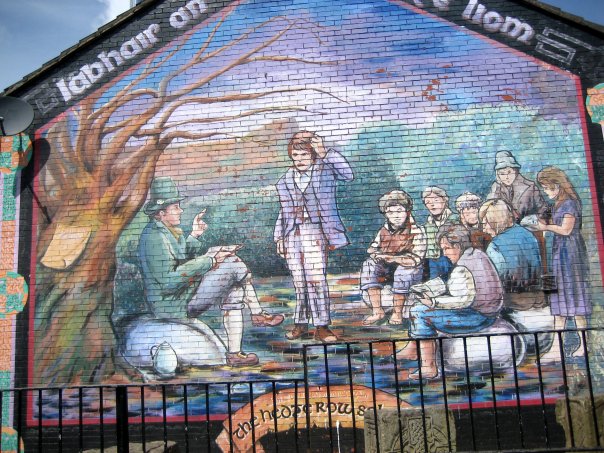
When education is outlawed...

And what could be a better reminder to the importance of information control than the Hedge School depicted here on a home in Belfast? In the 18th century, English laws would forbid Catholics from participating in education as teachers or students.  Every law was already written for the advantage of English settlers, but the crown still sought to solidify its control over the island by keeping its natives in a state of ignorance.  No law or army can forever protect tyrants from a well-educated populace…

Hedge schools started popping up in the 1600s, and they take their name from the rural or even outdoor environment classes were held in.  Despite a lack of school houses, despite legal bans, education went on under a tree or behind the bushes.  Knowledge would be passed on orally, even if the words had to be whispered.

Creating Opportunity with Knowledge

The imperial law was designed to keep wealth and power with one race of men over another.  Opportunity was rationed by who was allowed to eat what, or who was allowed to learn, or which church was allowed to say mass.  Every rule and regulation and job interview was designed to preserve this inherited imbalance of power, and yet education continued to create opportunity for those who were not “supposed” to have it.  Despite the crackdowns – or perhaps because of them – a new generation of rebels and civil rights agitators would rise up in the late 18th century armed with a knowledge of history and other basic academics.

No Less Valuable Today

While we may today take the freedom to pursue education for granted, it has not diminished in value.  To the contrary, modern technology has magnified and leveraged the value of knowledge and technical specialization.  The right skills can turn a $500 computer into a six-figure salary or a good bedside manner into a medical career that saves lives.

Resistance to Access

And America still has its own legacy of racially rationed education to cope with – and a contemporary crisis of class-based exclusion.  Although there are no laws forbidding racial or religious minorities, there are significant financial barriers to entry for those of a lower income lineage.  As education costs have risen faster than inflation, the effect has been to force more and more students into long term debt – a scenario that allows our current aristocrats to stake a future claim on all of the opportunity these young students create.

The resistance to education today is the same as it has always been – exclusion is a means of preserving social imbalance – and we’ve been heading in the wrong direction for far too long now.  The opportunity we gain from sharing information will always be greater than what the comfortable fear they will lose.